We are living in a world where 815 million people go to bed hungry every night, 155 million children are too short for their age, 52 million children are too thin for their height and billions of people are not getting enough nutrients in their diet. This crisis is costing the global economy billions of dollars every single year and billions of people are not growing (physically and mentally) to their full potential.
Hunger emerges the strongest and most persistently among people who are already poor, vulnerable and disadvantaged. By not addressing it, we could fail to reach all 17 Sustainable Development Goals (SDGs) and those who are most vulnerable will be left behind.

IN THE PHOTO: Burundi, May 2017. Mother-of-five Clotilde Nibigira (44) is thankful that her five-year-old son Clement is alive today thanks to the help she received from a Concern-supported Light Mother. Clotilde collects amaranth seeds from her plot of land where she also grows grow carrots, cabbage, onions, sweet potatoes and beans. CREDIT: Chris de Bode/Panos Pictures for Concern Worldwide
Why can’t we stamp out hunger?
The 2017 Global Hunger Index shows that steady progress has been made to end hunger, with global levels down 27 percent since 2000. But for the first time since then, in 2016, the number of hungry people actually increased, largely due to violent conflict and climate disasters that are pushing more people over the edge and making it harder to bounce back.
Two years ago, almost every government in the world signed up to a promise to end hunger and malnutrition by 2030 through the SDGs. But the world is off track to achieving this; this won’t only mean failing one of the goals, it would mean potentially failing all of them. A malnourished child is more susceptible to disease, they are more likely to be less productive at school, they will earn less as an adult, and they are more likely to give birth to a malnourished child, continuing the cycle for generations and making it almost impossible to achieve the 17 SDGs by 2030. The infographic below by the Scaling Up Nutrition Civil Society Network helps visualize the centrality of nutrition to all of the SDGs.
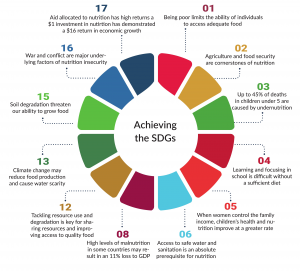
Yet, despite this, global investment to tackle hunger and malnutrition is alarmingly low. Only 0.5 budgets of aid budgets and less than 2 percent of government health budgets are allocated to nutrition. To address this issue, the Italian government rallied stakeholders from all over the world at the Global Nutrition Summit earlier this month.
Taking action at the Global Nutrition Summit
The Summit promised to encourage governments, donors, civil society, philanthropists, business and researchers to take responsibility, take action, and invest the much-needed funds to help tackle hunger and malnutrition.
It highlighted both the opportunities and challenges of current trends and how we should plan for the changes now to ensure a healthy, nourished and prosperous population in the future. Topics included the importance of planning healthy food systems in cities, where two thirds of the world’s population will be living in 2030; the importance of investing in adolescents given that there are 1.2 billion of them in the world with 16.2 million adolescent girls giving birth each year; and the importance of engaging the private sector to ensure nutrition is considered during all aspects of the supply chain – from seed production and distribution, to planting, to storage and transportation, to selling products at fair prices at markets.
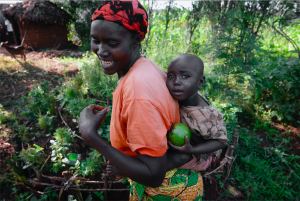
IN THE PHOTO: Burundi, May 2017. Mum-of-four Esperence Mutetiwabo (45) and her two-year-old daughter Delphine collect ripened avocados from their garden plot in Kirundo province, which has the highest childhood malnutrition levels in Burundi. A Concern-supported Community Health Worker discovered that Delphine was moderately malnourished when she was just six months old. CREDIT: Chris de Bode/Panos Pictures for Concern Worldwide
Accelerating progress to end hunger
Tackling hunger and malnutrition is at the core of Concern’s work. We currently operate in 26 of the world’s poorest countries and respond to emergency situations. Our aim is to accelerate progress to meet the Sustainable Development Goals through our programmes.
During emergencies, we ensure that the most vulnerable get enough nutritious food to eat and our longer-term work tackles the root causes of malnutrition. For example, recent projects include educating mothers on the importance of breastfeeding in Burundi; training smallholder farmers to grow a variety of nutritious and climate resilient crops in Malawi; improving water, sanitation and hygiene (WASH) for Syrian refugees in Jordan and Lebanon; and initiating health programmes to help communities manage acute malnutrition in Somalia.
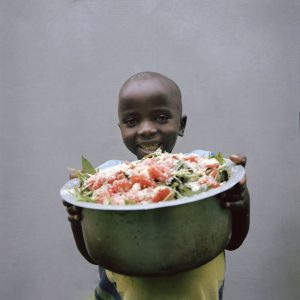
IN THE PHOTO: Burundi, May 2017. 5-year-old son Clément is alive today thanks to the support he received from a Maman Lumière (Light Mother). After being diagnosed as malnourished at just 17 months old, Clément and his mum Clotilde attended a series of Nutrition Sessions to learn new skills, receiving step-by-step instructions on food preparation and hygiene from a Maman Lumière. CREDIT: Chris de Bode/Panos Pictures for Concern Worldwide
We have the recipe to end hunger
Our experience in these countries, and the evidence gathered globally by many of the organisations at the Global Nutrition Summit means we know what it will take to end malnutrition. But political leadership from more countries and investment from influential actors is urgently needed.
I applaud the efforts made at the Global Nutrition Summit but we must not become complacent.
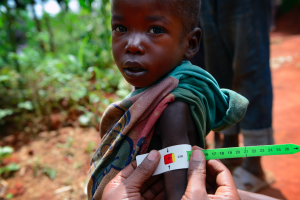
IN THE PHOTO: Burundi, May 2017. Edmond (3) is severely malnourished. He lives with his parents Jean-Marie Mbonimpa (30) and Jeannette Nzobamwita (26) and brother Pacifique (5) and 10-month-old sister Yves in a small banana-leaf-covered house in Marembo, Gisenyi, Kirundo. The family has just been selected to take part in a new phase of Concern’s graduation programme. CREDIT: Chris de Bode/Panos Pictures for Concern Worldwide
We are still falling far short of the $7 billion needed each year to reverse the worrying statistics and accelerate progress to ending hunger. A significant increase in investment is needed to make a dent in the numbers of children who are suffering and dying, from malnutrition.
And in addition, at the Summit, political leadership was promised by governments from Cote d’Ivoire, El Salvador, Madagascar, Niger, Rwanda, Ethiopia, and Brazil. However, there are many governments from high-burden countries that weren’t present and didn’t make promises to improve political commitment. These are the governments that hold the power to improve policy and practice.
So let’s build on the momentum from Milan, let’s reach the furthest behind first and let’s keep our promise to the world’s poorest people. I am hopeful that with the right investment and leadership we can end hunger by 2030, for good.

IN THE PHOTO: Burundi, May 2017. Single mum Espérence Ndayishimiye (26) would like to grow cassava on the small plot of land in front of her house to help feed her two children, but it is rocky and not fertile.
CREDIT: Chris de Bode/Panos Pictures for Concern Worldwide
Editors note: The opinions expressed here by Impakter.com columnists are their own, not those of Impakter.com